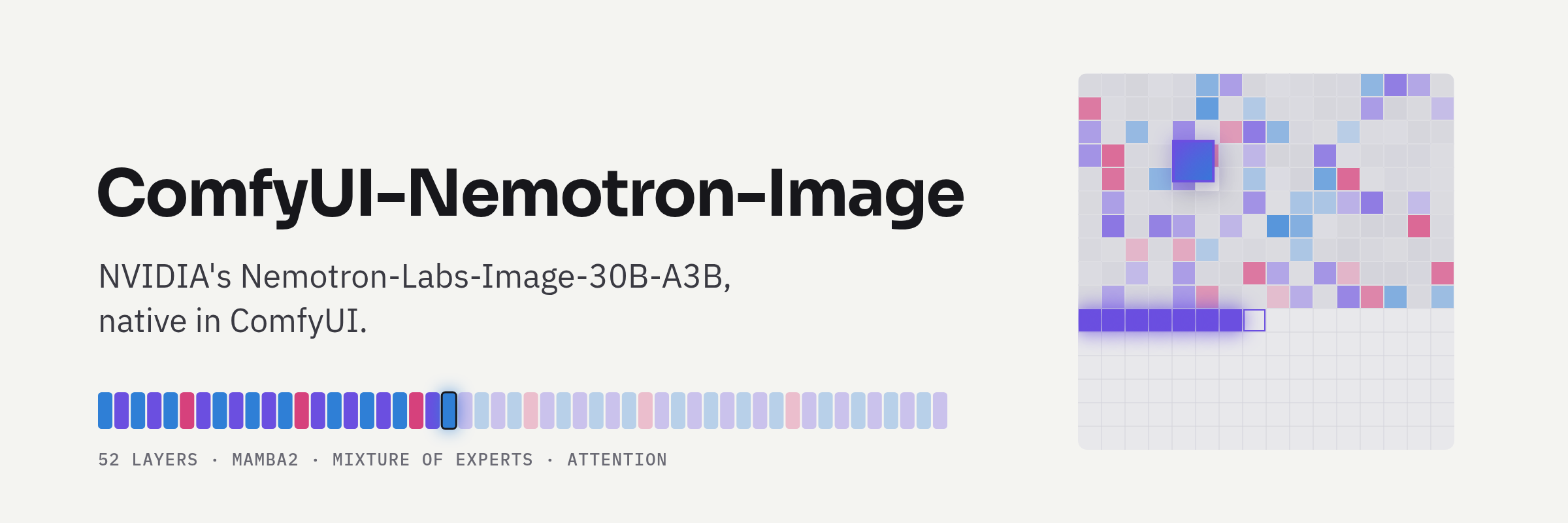
User PedroMarinhoDev has released an unofficial set of ComfyUI-Nemotron-Image nodes that runs NVIDIA's autoregressive text-to-image model Nemotron-Labs-Image-30B-A3B directly in ComfyUI. W4A8 quantization and offloading inactive MoE experts to system RAM allow the 30B model to run on local graphics cards with 12 GB VRAM or more, although quality remains experimental for now.


What happened
PedroMarinhoDev published the ComfyUI-Nemotron-Image repository on GitHub with three nodes: Load Nemotron Image, Nemotron Image Generate, and Load Nemotron Image Decoder, followed by standard VAE Decode. Five quantized weight sets are available on Hugging Face, ranging from 22.7 GB (W4A8) to 65.3 GB (bf16), plus a 1.24 GB pixel decoder. According to the author's measurements, on an RTX 4090, a 1024×1024 image (4250 tokens) generates in 26.1 seconds in warm mode with W4A8, 6.6 seconds per image in a batch of 8, and approximately 233 seconds in bf16. On cards with 16 GB VRAM, W4A8 runs in 36.1 seconds, and on 12 GB cards, in 77.2 seconds. The author marks the release as an experimental preview: text in images is sometimes distorted, and there are artifacts and anatomy issues.
Context
The base model nvidia/Nemotron-Labs-Image-30B-A3B has already been published by NVIDIA on Hugging Face: it is an autoregressive MoE generator with 30B parameters (32.6B in the base version) and 3B active parameters per token, which writes images using 16×16 pixel codes line by line. PedroMarinhoDev's contribution is not a new model, but an engineering port: adaptation for ComfyUI and custom CUDA kernels that calculate the token step. The memory management scheme assumes that experts that do not fit in VRAM reside in system RAM with a cache on the graphics card. The NVIDIA license restricts model use to non-commercial purposes.
Why this matters for the industry
The release shows that an autoregressive MoE model with image generation using 16×16 tokens can be integrated into node-based pipelines, and that W4A8 quantization with expert offloading to RAM and GPU caching makes the 30B model suitable for local cards with 12 GB or more. This is an important benchmark for optimizing large AR generators for local inference: the hybrid memory pattern will likely be replicated in other AR generators and optimized ComfyUI nodes. However, this is not a production product, but a strong engineering proof of concept that reduces the cost of experimenting with the AR approach without renting servers.
Why this matters for users
Users with RTX 4090 or RTX 3090 can clone the repository into custom_nodes right now, download the 22.7 GB W4A8 file from Hugging Face, and run a sample workflow in ComfyUI to see how NVIDIA's AR model writes images live: the preview updates as lines are generated. On cards with 12-16 GB VRAM, inference works but is slow — 36-77 seconds per frame. Commercial use is prohibited by the NVIDIA license, and quality is currently experimental, so this is a tool for local experiments, not for production.
What is still unknown / limitations
All figures — 26.1 seconds in warm mode, 6.6 seconds per image in a batch of 8, 4250 tokens per frame — are the author's own measurements, without independent reproduction, without specifying timing accuracy, and without comparison to diffusion baselines in terms of quality. It is not possible to claim the superiority of the AR approach over diffusion based on this data: 36.1 seconds on 16 GB and 77.2 seconds on 12 GB is slow experimental inference, comparable to diffusion models in bf16 on the same hardware. Production deployment is excluded due to experimental quality and the non-commercial license.
Sources
- PedroMarinhoDev/ComfyUI-Nemotron-Image — GitHub (unofficial nodes for Nemotron-Labs-Image-30B-A3B in ComfyUI)
- PedroMarinhoDev/Nemotron-Labs-Image-ComfyUI — Hugging Face (quantized weights W4A8/W6A8/int8/bf16 and pixel decoder)
- nvidia/Nemotron-Labs-Image-30B-A3B — Hugging Face (NVIDIA base model, 32.6B parameters, NVIDIA License)
Author
Look at AI, editorial team