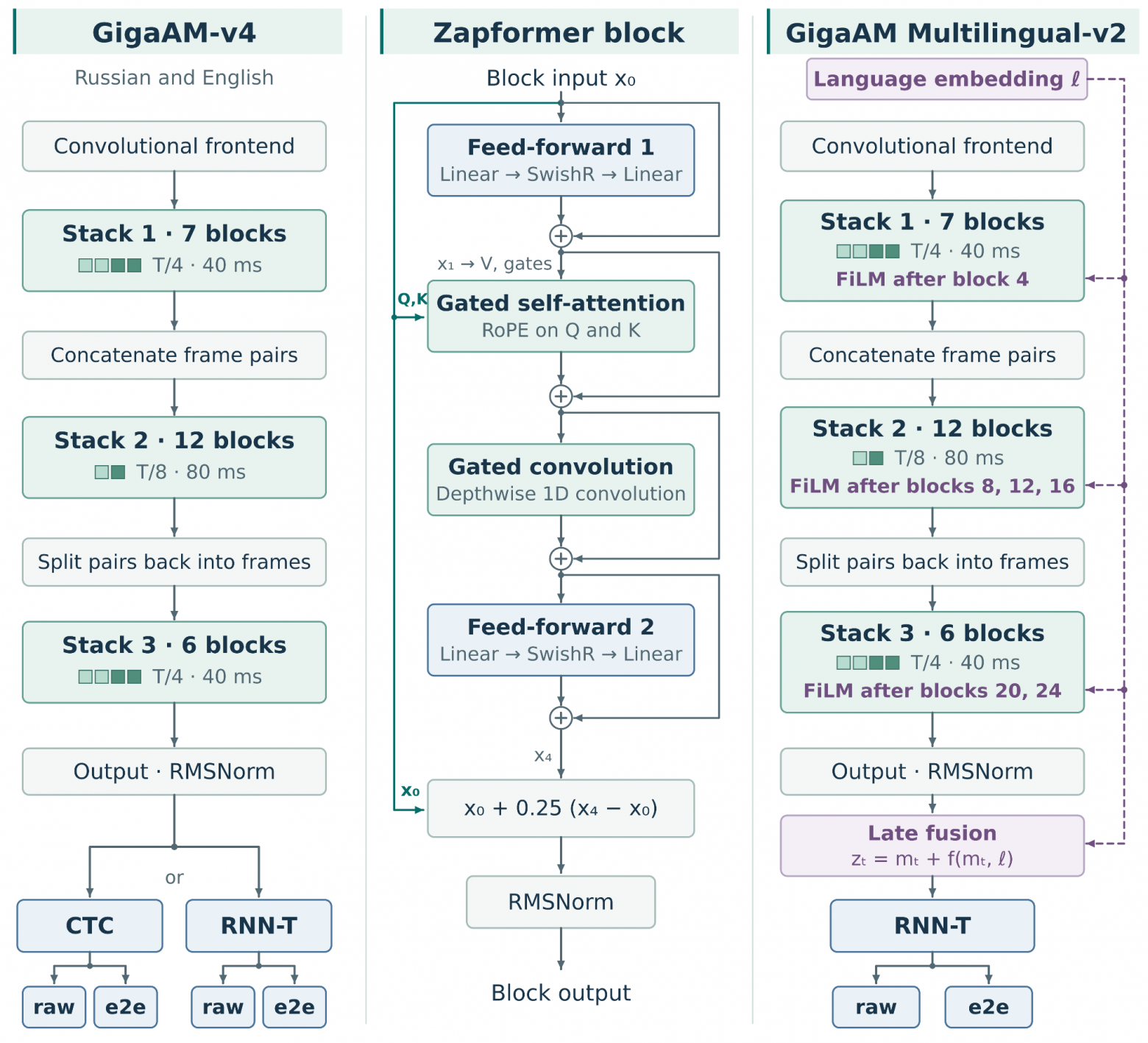
Sber has released a new generation of open ASR models: GigaAM-v4 (238M parameters) and GigaAM Multilingual-v2 (774M parameters, 21 languages). Both models are built on the new Zapformer encoder architecture, support streaming recognition with configurable latency of 160, 320, and 640 ms, and return two transcriptions: raw and formatted with punctuation, capitalization, and numbers. The code and weights are open under the MIT license.
What Happened
Sber published two new speech recognition models. GigaAM-v4 contains 238M parameters and was trained on 7 million hours of unlabelled audio data and 58,000 hours of labelled data. GigaAM Multilingual-v2 contains 774M parameters and supports 21 languages. Both models use the new Zapformer encoder architecture, operate in streaming mode with 160, 320, or 640 ms latency, and simultaneously output a raw transcription and formatted text with punctuation, capitalization, and numbers. The stated average WER for GigaAM-v4 in Russian is 5.99%, compared to 9.51% for the previous v3 version, corresponding to an approximate 37% relative reduction. For English, accuracy is claimed to be higher than Whisper large-v3 with a significantly smaller model size. Multilingual-v2 shows the best accuracy among open models for CIS languages: for example, 95.7% in Tatar versus 49.3% for Omni LLM 7B v2, and superiority over Qwen3-ASR and Nemotron 3.5 Transcribe is claimed for German, Italian, and Portuguese. Code and weights are available on GitHub (salute-developers/GigaAM) and Hugging Face (ai-sage/GigaAM) under the MIT license.
Context
GigaAM is a line of open speech recognition models from Sber, where v4 is an update to the previous v3 version, which had an average WER of 9.51% in Russian. The new generation differs not only in data but also in architecture: the Zapformer encoder, ScaledMuon optimizer, and a proprietary 1.33M parameter VAD module have been introduced, meaning both the architecture and the training recipe have changed, not just the data scale. In the segment of open ASR models, strong competitors remain Whisper large-v3, Qwen3-ASR, and Nemotron 3.5 Transcribe; meanwhile, CIS languages have traditionally been a weak point for open solutions, making the positioning of Multilingual-v2 across 21 languages a notable shift.
Why This Matters for the Industry
An open, compact ASR model with streaming mode and a claimed 5.99% WER in Russian covers typical scenarios for voice interfaces, call centers, and dictation without dependence on closed APIs. The Zapformer architecture, ScaledMuon optimizer, and open VAD provide a reproducible recipe for fine-tuning on domain data, lowering the barrier to entry for teams building voice products. The MIT license and ready deployment paths (gigaam pip package, transformers, ONNX export, Triton/TensorRT support) allow speech recognition to be integrated into proprietary products and edge devices. If results are confirmed by independent benchmarks, the GigaAM line may set a new class of compact open ASR models with streaming mode and shift the accuracy-to-size ratio benchmark.
Why This Matters for Users
The model can be downloaded and run locally right now via the gigaam pip package or transformers (ai-sage/GigaAM-v4, revision rnnt/ctc); a Colab example, ONNX export, and Triton/TensorRT support are available. For readers, this means a ready-made solution for pilot projects: dictation, voice interfaces, offline recognition, and transcripts with automatic text formatting. For Russian-language products, this is a potential replacement for closed ASR APIs in typical scenarios, and across 21 languages, the model is particularly strong in CIS languages, where the best open alternatives are significantly weaker. For production with high requirements for latency and load, independent load testing on target hardware will be required.
What Is Still Unknown / Limitations
All key metrics—5.99% WER in Russian, comparison with Whisper large-v3 in English, and accuracy across 21 languages—are provided in Sber's announcement and have not been confirmed by independent verification. The provided sources do not include a table with specific WER figures per benchmark, so the comparison with Whisper large-v3 cannot yet be verified. The 95.7% metric for Tatar appears to be accuracy rather than WER, indicating a mix of metrics in the announcement. A full description of benchmarks and measurement conditions is absent from the provided materials.
Sources
- GigaAM-v4 and GigaAM Multilingual-v2: Streaming recognition, 21 languages, and a new quality level (Habr, Sber)
- salute-developers/GigaAM — Foundational Model for Speech Recognition Tasks (GitHub)
- ai-sage/GigaAM-v4 (Hugging Face)
Author
Look at AI, editorial team