On November 24, 2026, Sand.ai unveiled MAGI-2, its flagship video generation model featuring 480 billion parameters (MoE, with approximately 28 billion active per token) and trained on roughly 4 trillion tokens. The model creates up to 30 seconds of 1080p video at 25 fps in a single pass, simultaneously generating audio such as speech with lip-sync, music, and sound effects. The official Sand.ai API and partner access via VidMuse are already available, while the weights remain closed; the company has promised an open-source release and a technical report.

What Happened
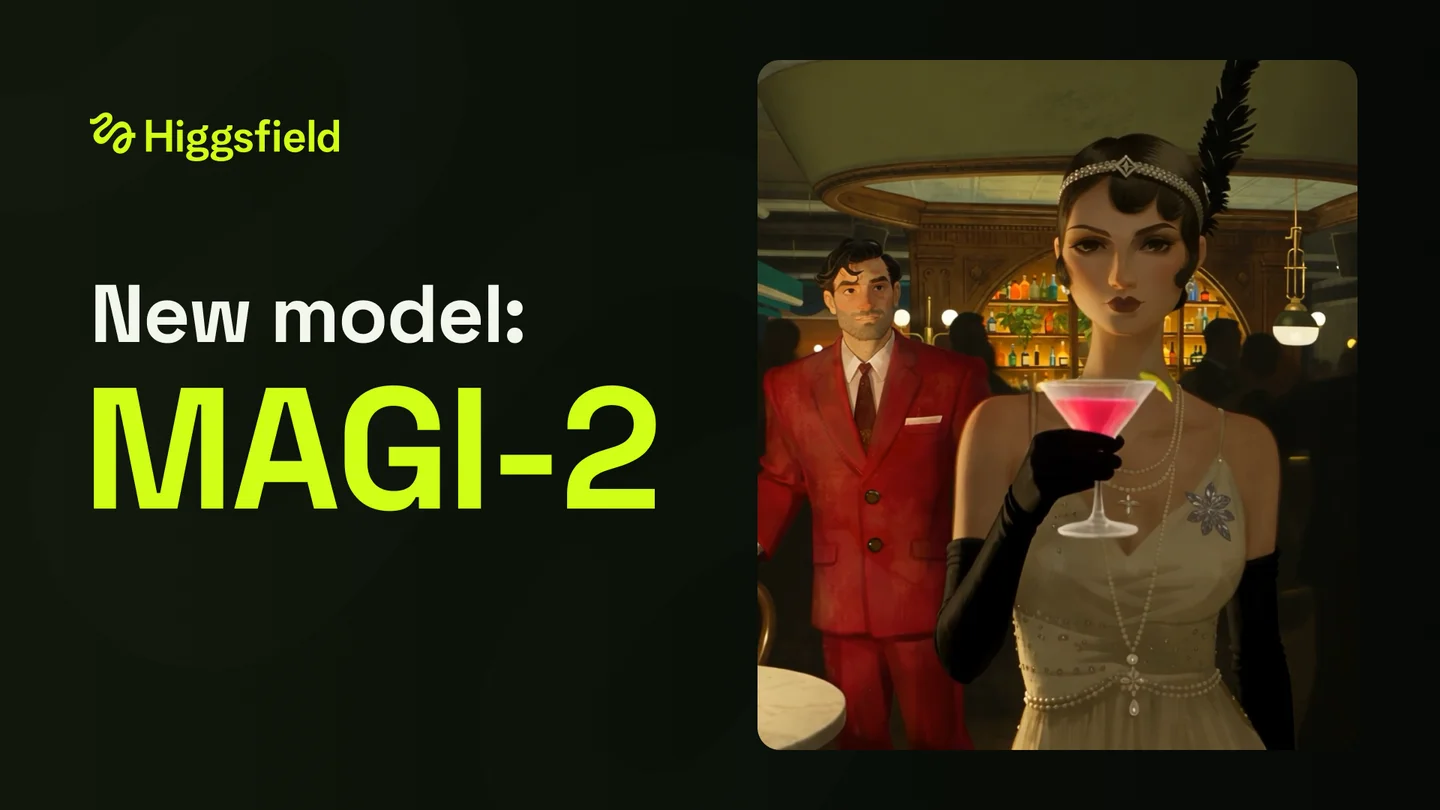
MAGI-2 accepts up to 20 multimodal references in a single request: 10 images, 5 videos, and 5 audio files. It features scene control via timecodes and targeted edits to existing video. The official API is priced at $0.80 for 10 seconds and $2.40 for 30 seconds; on the partner platform VidMuse, the rate is 8 credits per second for 1080p. According to Higgsfield Video Arena (snapshot from November 24, 2026), MAGI-2 ranks second with a score of 1146 and a win rate of 60.5%, trailing only Seedance 2.5 (1219 points) but outperforming Seedance 2.0 (71%), Wan 3.0 (79%), and Kling 4.0 (83%) in blind comparisons.
Context
Prior to MAGI-2, the segment for long (30-second) video clips with audio was dominated by Seedance 2.5, Wan 3.0, and Kling 4.0, none of which offered a comparable price per second. Joint generation of image and audio in a single pass, rather than post-processing, is a relatively new solution for the industry: it changes the architecture of video production pipelines. The MoE architecture with ~28 billion active parameters per token out of 480 billion total is a claim to frontier-level computational budget, but without a technical report, the expert distribution and audio track training method remain unknown.
Why This Matters for the Industry
MAGI-2 shifts the price benchmark in the category of long clips with audio: 30 seconds in 1080p for $2.40, with quality that in Higgsfield Video Arena blind tests surpasses Seedance 2.0, Wan 3.0, and Kling 4.0, forces competitors to respond on the quality/price ratio. For production, the model can already be connected as an external API (Sand.ai or VidMuse) for offline and semi-online tasks: scheduled clip generation, A/B creative generation, and prototyping. The promised open-source release of weights could provide the community with a strong open multimodal model at the 480B level and shift the "API vs. own hardware" decision toward self-hosting and domain fine-tuning.
Why This Matters for Users
The model is already available to try via partner VidMuse (8 credits per second, 1080p) or the official Sand.ai API ($0.80 for 10 seconds, $2.40 for 30 seconds). The key capability is up to 20 references (10 images, 5 videos, 5 audio) for fixing characters, environments, and sound, plus timecodes for changing shots within a clip. Sand.ai recommends long, structured prompts with time markers rather than short descriptions. Specific scenarios include: a 30-second commercial spot based on a brief with brand references, a "script → timecodes → MAGI-2 → finished clip with audio" pipeline, and iterative edits to existing video.
What Is Still Unknown / Limitations
There is no independent technical report, and the weights are closed, so the MoE architecture, the training method on ~4 trillion tokens, and the quality of audio-video synchronization cannot yet be verified. The only quantitative evidence is Higgsfield Video Arena, which is a third-party leaderboard rather than a standardized benchmark: the methodology for selecting pairs and the sample size are not disclosed. The accuracy of timecode adherence, character stability between scenes, and lip-sync quality are not confirmed in the sources. For real-time or interactive scenarios, there is no data on latency, so the model cannot be included in SLAs.
Sources
- Sand.ai — Official MAGI-2 Blog
- Higgsfield — MAGI-2 Announcement
- Imagera AI — MAGI-2 Specifications and Prompt Templates
Author
Look at AI, editorial team