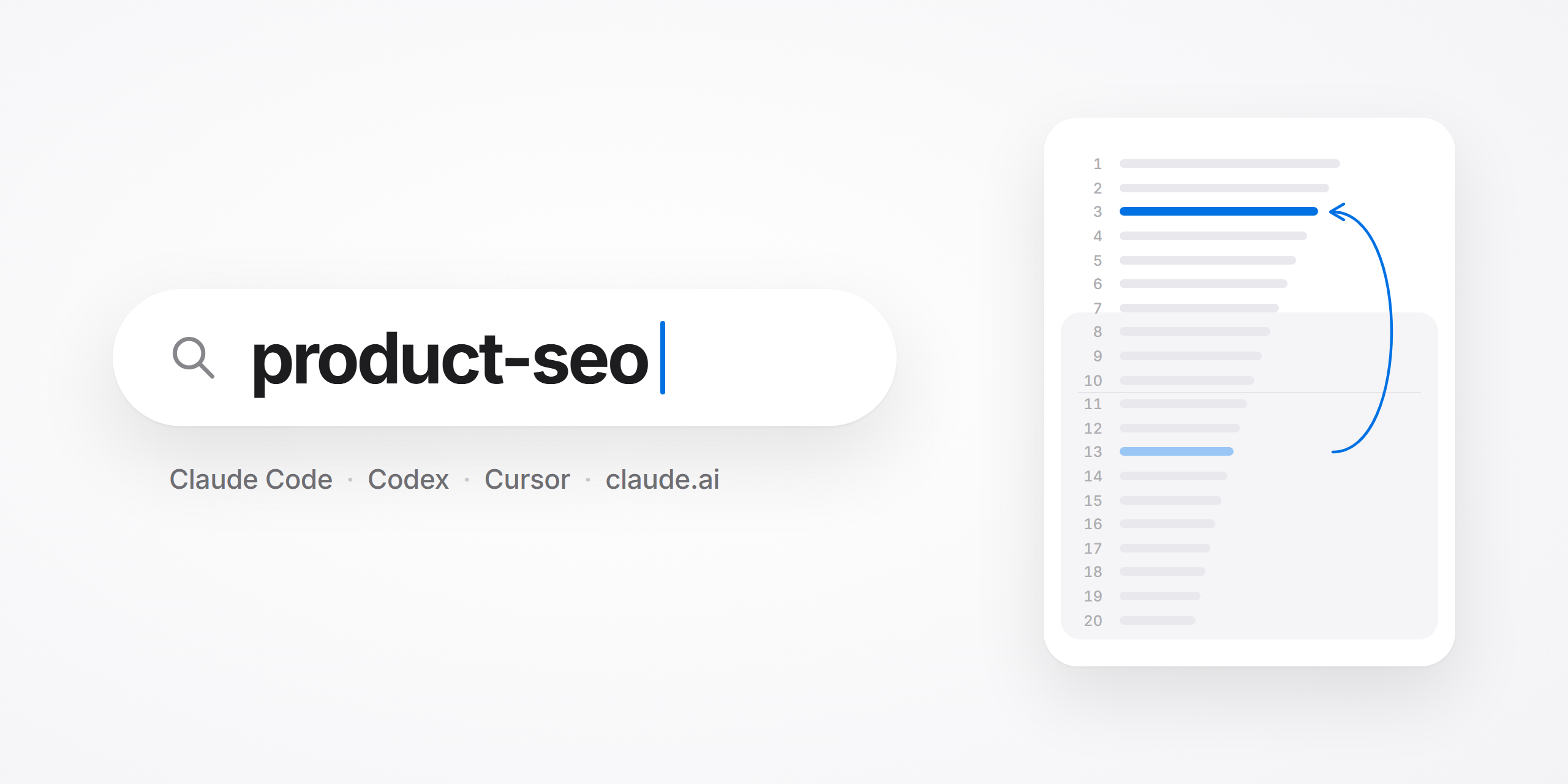
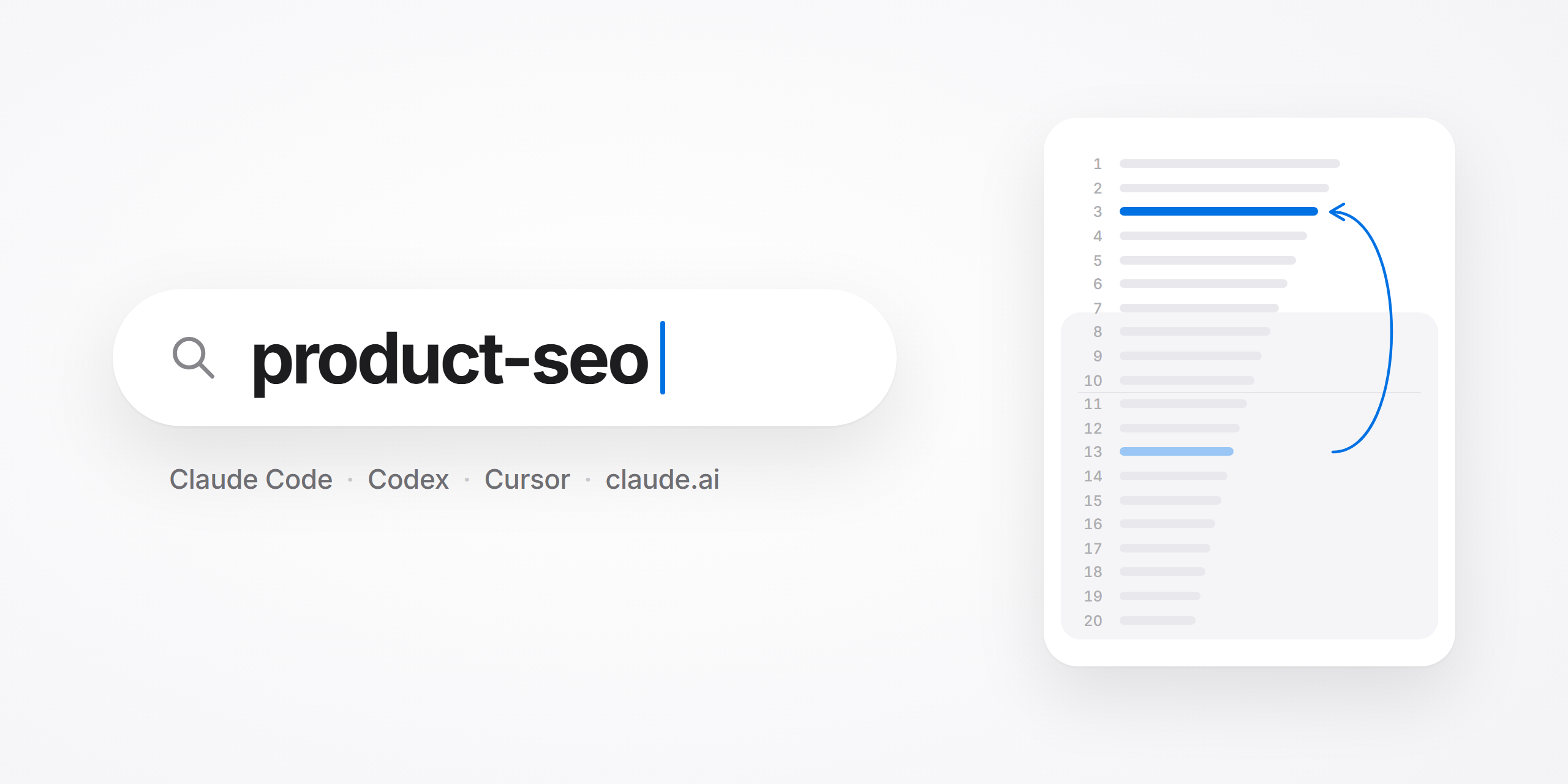
The author of the Tips AI Telegram channel (Igor Trunin) published the open-source skill product-seo version v0.1.0 under the MIT license: this is a package of rules and Node.js scripts that Claude Code, Codex, and Cursor coding agents execute as a cohesive process — from analyzing queries from Google Search Console to rewriting pages, checking effects, and rolling back changes. According to the author, over three months of applying the methodology on his site HypeScribe, CTR in Google grew from 0.4% to 0.9%. The result is currently confirmed by only one case, but the product type itself — a skill that installs with one command and runs a measurable process according to recorded rules — is a notable example of a new format.
What happened
The tipsai/product-seo repository appeared on GitHub with an open skill for coding agents. Inside is a SKILL.md file describing the process, reference guides on 'games' (query triage, audit, page rewriting, comparisons, and llms.txt for AI search), and seven Node.js scripts. The skill is designed for Claude Code, Codex, and Cursor: basic installation is done with the command npx skills add tipsai/product-seo, and in Claude Code and Codex it can be installed as a plugin — via /plugin marketplace add tipsai/product-seo and codex plugin marketplace add tipsai/product-seo. At the time of checking, the repository had 22 stars and 2 forks, release v0.1.0 is dated 2026-11-16, and the announcement was posted in the Tips AI Telegram channel on the same day. Russian documentation is available in README.ru.md and in the docs/ru directory.
Context
The methodology was not written on paper but tested on the author's live site: HypeScribe gained about 1 million impressions and 9K clicks in Google from August to early November 2026. The point of the approach is not secret techniques, but the discipline of their application. Queries from Search Console undergo triage based on the criterion 'is this a product answer': this allows the agent to separate pages where it makes sense to rewrite text for the product from the rest of the query mass. Facts about competitors are collected by a separate agent, which is allowed only official sources and only with a quote, link, and date. Each change undergoes verification according to a pre-recorded rule: metric comparison at week one and week three, and a rollback if clicks drop by 30% or more. Some reference guides already target the next iteration of search — optimizing page visibility in AI search, showing where the methodology's vector is directed overall.
Why this matters for the industry
The set of techniques is not what matters — they have been known for a long time — but the packaging: the agent skill here transforms from a one-off prompt into a versioned artifact with a license, documentation, and one-command installation, meaning the methodology is distributed as a package. The second strong part of the design is pre-registered verification rules: comparison points and rollback thresholds are recorded before changes begin, which turns agent actions in production into a prototype of a controlled experiment — this is rarely seen in tools of this class. Transferable to other domains are the built-in limiters: the 'is this a product answer' rule and the requirement for a quote with a link and date when collecting facts about competitors — this is grounding built into the process, not delegated to the model. If the format takes hold, it is logical to expect waves of vertical skills — for support, analytics, documentation, sales — and competition of registries and marketplaces around Claude Code, Codex, and Cursor. On the horizon of a couple of years, routine content operations may be codified into executable playbooks with eval-gates and rollback rules, and the focus of SEO may drift from classic search results to visibility in AI search.
Why this matters for users
If you have a product site and access to Google Search Console, a pilot can be set up within one day: Search Console data is exported to CSV, and the agent is sent the request 'Set up SEO for my site'. Then it will itself sort queries into two piles, propose the first three actions, rewrite selected pages, and schedule comparisons. Paid tools are not required, infrastructure load is zero, scripts run locally, Node.js 18+ is needed for helpers, and costs are limited to agent session tokens. Note that this is a tool with delayed feedback: the first look at the effect will appear no earlier than the first scheduled comparison, and a stable outcome will become visible after a series of successful edits. Russian documentation in README.ru.md and docs/ru allows you to first read the methodology in full, and then let the agent run on a live site.
What is currently unknown / limitations
Trust the numbers cautiously for now: there is only one case, metrics are published by the methodology author on their own site, there are no control pages, raw impression and click series are not disclosed, and seasonality and search result updates were not taken into account. Therefore, the CTR growth from 0.4% to 0.9% cannot be causally attributed to the methodology. The rollback rule 'click drop of 30% or more' is set without considering the basic variance of the metric: the weekly click series at this traffic is inherently noisy, and a fixed threshold may trigger on natural fluctuations. The repository was published literally the day before the review, there are no independent replications on other sites yet, so the working process has not yet been separated from the n=1 impressive case.
Sources
- GitHub — tipsai/product-seo: SEO skill for Claude Code and Codex (README, release v0.1.0)
- README.ru.md — Russian version of the product-seo skill documentation
Author
Look at AI, editorial team