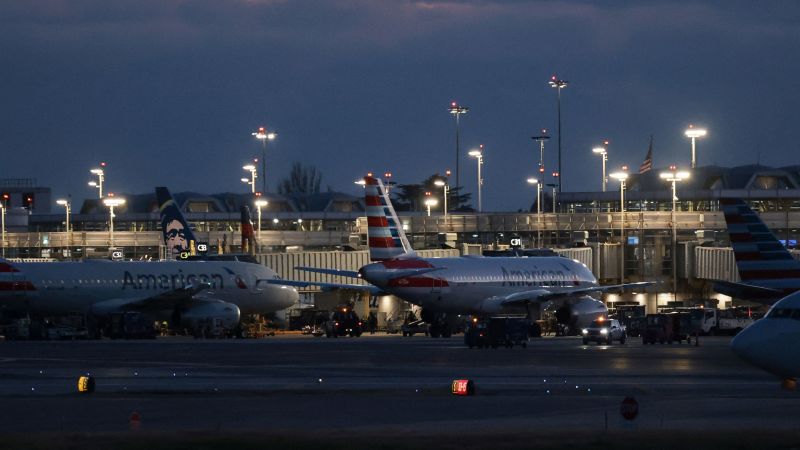
On November 13, the FAA issued a ground stop at all US airports—the third such incident in history after September 11, 2001, and the NOTAM system failure in January 2023. The official explanation is a telecommunications failure in legacy infrastructure; however, the Department of Homeland Security has ordered an investigation into whether the new FAA SMART cloud AI platform, which was connected to all 22 air traffic control centers three days before the failure, is responsible for the incident. The ban lasted more than four hours, affecting over 15,000 flights, with disruptions continuing on Saturday.


What happened
The ground stop took effect on November 13 at 3:54 PM Eastern Time (11:54 PM MSK); at that moment, more than 3,500 aircraft were in the air. Departures were authorized at 8:15 PM Eastern Time, more than four hours later. According to FlightAware data cited by CNN, over 7,700 flights were canceled and more than 8,000 delayed on Friday. Transportation Secretary Sean Duffy attributed the failure to router overload in the "extremely old" air traffic control system, while Homeland Security Secretary Markwayne Mullin described the incident as a "telecommunications failure across the Administration" and emphasized that there are no signs of a malicious attack. The failure occurred three days after the new AI platform was fully connected to the air traffic control center network, leading to its inclusion in the official investigation. Cancellations have continued for two consecutive days.
Context
The SMART (Strategic Management of Airspace, Routes and Trajectories) platform is an FAA cloud system that centralizes 200 data streams: weather, trajectories, sector load, and controller shifts. According to its architectural description, it is not automation but decision support: SMART recommendations are reviewed by specialists at the Washington SMART center and the Warrenton, Virginia command center, final decisions are made by local managers, and aircraft separation is handled by controllers. The system is operated by vendor ASI under a 12-year contract worth $875 million. According to the channel, SMART was connected to all 22 air traffic control centers on November 10, and the failure occurred on November 13; Mullin linked the accidents to "patching new into old," and the cybersecurity agency CISA has joined the investigation, according to the channel. ASI publicly stated on X that the failure "is not based on the SMART system and was not a result of its operation." The temporal proximity of the integration and the accident is weak evidence in itself: it is a temporal correlation, not an established cause, and the simultaneous activation of all centers contrasts with the phased rollouts with testing and rollback that are considered standard practice in ML engineering.
Why this matters for the industry
This incident is a precedent for the entire government AI market: even a recommendation system where humans make decisions has been subjected to official investigation. This leads to three specific effects: major AI integrations into critical US infrastructure are effectively frozen during the investigation; existing contracts like SMART will be reviewed with requirements for provable isolation from legacy networks, phased connection, and auditable interfaces; and AI vendors will face longer deal cycles and increased demand for integration audits. In parallel, the failure has accelerated the budget wave for air traffic control modernization: Trump is urging Congress to pass a corresponding law, Senator Eric Schmitt is promoting the $30 billion Modern Skies Act, and the Office of Management and Budget, led by Russ Vought, together with Duffy, requested these $30 billion in a letter to Congress hours before the failure; Mullin estimates the full FAA modernization at approximately $50 billion. If the investigation confirms the telecom version, the historical conclusion will not be "AI broke aviation," but "a new system was connected to an overloaded old one without sufficient isolation"—and a platform market will form around such modernization following the SMART template: data stream aggregation, recommendation loop, and human verification.
Why this matters for users
If you are planning flights to or through the US this weekend, check your flight status before heading to the airport: more than 2,000 flights have already been canceled on Saturday, and hundreds of delays are expected. JetBlue and Air Canada canceled all flights on Friday, while United and Southwest have introduced penalty-free rebooking—in case of cancellations and delays, this is the simplest path, so keep airline notifications enabled and review rebooking terms in their app in advance. Those with connections at US hubs should prepare for a long chain of reschedules, as the consequences of the four-hour departure stop will ripple through schedules for more than a day. Headlines like "AI stopped the country" should be read cautiously for now: SMART only aggregates data streams and prepares recommendations, while humans still make decisions at the FAA, so it is more reliable to rely on the findings of the official investigation rather than initial versions.
What is currently unknown / limitations
There are no conclusions from the investigation yet: CISA inspection results have not been published, and the exact technical attribution of the failure—which specific routers and networks failed—has not been officially named. ASI's statement that SMART is not responsible is the word of a vendor operating under an $875 million contract, and there is no independent confirmation in available materials. Open data also lacks SMART testing methodology, recommendation quality metrics, and a description of the rollout scheme: it is unknown exactly what accompanied the connection of all 22 centers on November 10. Finally, the link "connection three days ago—failure today" is a temporal correlation, not an established cause.
Sources
- CNN — Live updates on FAA ground stop
- FAA Newsroom — General Statements (ground stop and SMART Expanding Across the Nation)
Author
Look at AI, editorial team