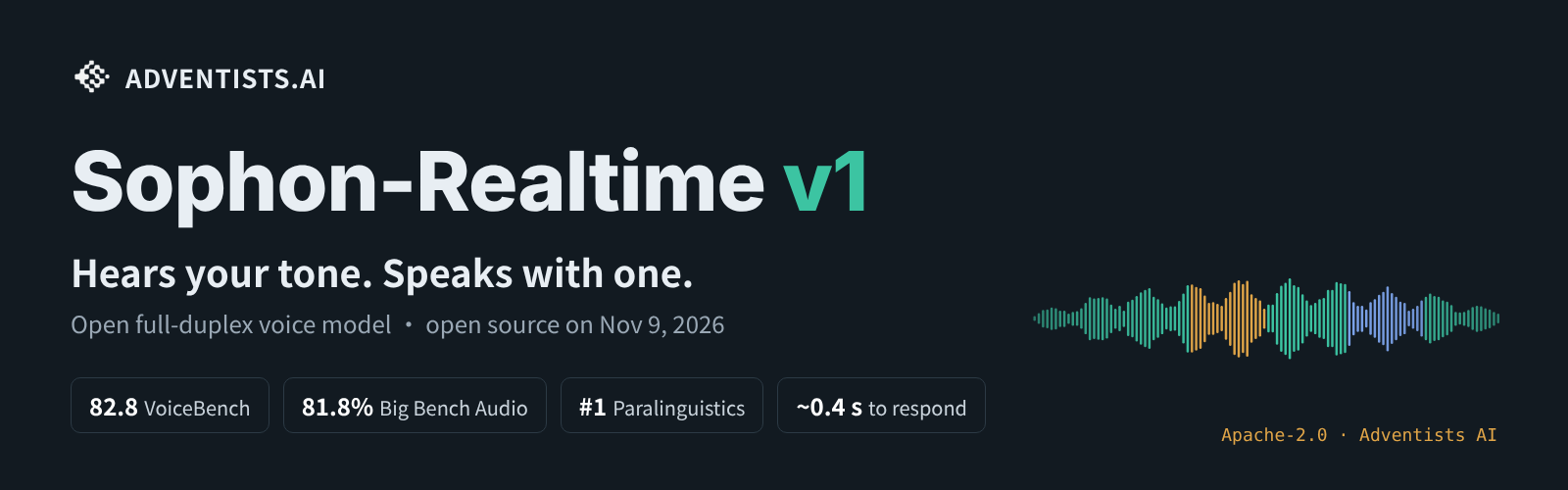
On November 8, 2026, the Adventists AI team released the Sophon-Realtime v1 family of full-duplex voice models: code and weights of approximately 42 GB are available under the Apache 2.0 license on GitHub, Hugging Face, ModelScope, and PyPI. The three builds—Tag, Flash, and E2E—share a common 32B 'brain' that continuously listens to the interlocutor, independently determines the end of a turn, and prepares a draft response from the first pause. According to the authors, the model scores 82.8 on VoiceBench—a level comparable to GPT-4o-mini-Audio and the top spot among open full-duplex solutions—however, all figures are currently self-reported measurements, and the model only understands English and Chinese.


What happened
The builds differ only in how they vocalize the same 32B core. Tag delivers the first audio in approximately 0.6 seconds and supports 16 simultaneous users on a single 80-GB GPU, annotating responses with audio tags like [laughter], [sigh], or commands to take a breath—which are played by a separate speech synthesis model. Flash is lighter and faster: 0.31 seconds to first audio and up to 40 users on the same card. E2E is a research preview where the talker is embedded directly into the 32B model and requires two GPUs to run. The server is started with the command sophon-realtime serve and immediately opens a WebSocket at ws://HOST:8000/v1/realtime with full duplex and barge-in capabilities, as well as a POST /v1/chat/completions endpoint that accepts audio input and returns text and audio output.
Context
A full-duplex model differs from the familiar 'speak when I'm done' scheme: both participants share a single channel, and the system must independently determine when the interlocutor's phrase is complete, react to interruptions, and avoid inserting unwanted pauses. Until now, such behavior remained the privilege of closed audio APIs like GPT-4o-mini-Audio. In Sophon-Realtime, the decision to switch turns is made by a common 32B 'brain' built on an adapted Qwen3-VL-32B-Instruct: voice capabilities were layered on top of a vision-language model that continuously listens and holds a ready draft in advance, marking where to laugh, sigh, or take a breath. The Apache 2.0 license explicitly permits commercial use, and LoRA fine-tuning on a single GPU allows adjusting the persona or domain without retraining the entire model.
Why this matters for the industry
Essentially, this is the first open full-duplex stack that, on paper, catches up with closed solutions: it claims the top spot among open full-duplex models on VoiceBench, 48% Pass@1 on Full-Duplex-Bench v3 compared to 43% for Grok, paralinguistic understanding of 48.6 compared to 46.9 for Gemini 3.8 Flash and 44.6 for Qwen3-Omni, plus 81.8% on Big Bench Audio. The economics of live voice are also changing: instead of per-minute billing for a closed API, the cost is shifted to a pool of own cards, where a single 80-GB GPU supports, according to the authors, 16 (Tag) or up to 40 (Flash) simultaneous dialogues with a latency of fractions of a second to first audio. The live mode speaks the OpenAI GPT-Live protocol, which reduces the migration cost for existing clients, and the 'common 32B brain plus swappable vocalization' template becomes a verifiable architectural benchmark for future open voice models.
Why this matters for users
For a reader with a single 80 GB card (H100, H800, or A100 80G), the model is available today: pip install sophon-realtime, then sophon-realtime serve. The choice of build is determined by the scenario: Tag with audio tags is suitable for 'live' characters and demos, Flash with 0.31 seconds to first audio and up to 40 users per card is for call centers and in-car scenarios, and E2E is a research option at the cost of a second GPU. Existing clients speaking the OpenAI GPT-Live protocol can migrate to this stack by changing the URL and key. The main practical barrier is languages: the model only knows English and Chinese, so it is not suitable for Russian-language services in its original form; LoRA fine-tuning on a single GPU leaves a path to adaptation, but there are no ready-made Russian adapters yet.
What is currently unknown / limitations
All key figures—VoiceBench 82.8, Big Bench Audio 81.8%, paralinguistic understanding 48.6, Full-Duplex-Bench v3 Pass@1 48%, latencies of 0.31–0.6 seconds, and density of 16–40 users per GPU—are self-run measurements by the authors: the methodology and testing conditions (network, batching, load profile) are not disclosed in available sources, and there is no independent verification yet, so density and latency should reasonably be considered upper estimates. The base is Qwen3-VL-32B-Instruct, a vision-language model adapted for voice: the specifics of cross-modal adaptation and training data are not described, so robustness to noise, accents, and long dialogues is not covered by the stated results. E2E remains a research preview on two GPUs. The expected wave of independent re-verification of the stated benchmarks in the coming months is an interpretation, not an established fact, and the figures may be adjusted downward.
Sources
- adventists-ai/Sophon-Realtime-v1 — Hugging Face (official model card)
- adventists-ai/sophon-realtime — GitHub (official repository, README, demos, benchmarks)
- Adventists AI Open-Sources Sophon-Realtime v1 Full-Duplex Voice Models — AICoder (independent news analysis)
Author
Look at AI, editorial team